
Google SEO 2026: The Complete Guide to Getting Your Small Business Out of the Shadows
Of the 8.5 billion searches performed on Google every day, the vast majority of web pages never capture a single one of them. According to a Backlinko study covering 14 billion pages, 90.63% of pages indexed by Google receive zero organic traffic. In other words: being online isn’t enough. You still have to be found.
And yet organic search remains the most cost-effective acquisition channel over time for a small business. This complete guide explains why, and more importantly, how to make the most of it in 2026.
Why SEO Still Matters for a Small Business in 2026
- Organic search generates 53.3% of all trackable web traffic worldwide (BrightEdge Research, via Digital Gagnant)
- 43% of e-commerce traffic comes from Google organic search, ahead of social media and paid advertising (Incremys, 2026)
- SEO’s return on investment is 5 times higher than paid channels over the long term (Cipen, 2026)
- 74% of French SMBs now invest in organic search in some form, and 65% have already worked with an external provider (France Num 2025 Barometer, via Digital Gagnant)
With nine pages out of ten generating zero traffic, publishing content clearly isn’t enough. And contrary to popular belief, the difference between a site that thrives on SEO and an invisible one almost never comes down to how many articles are published, it comes down to how deeply each topic is covered. A site with 20 interconnected articles on the same subject almost always outranks a site with a single “perfect” but isolated article, even if that article is technically better written.
The 4 Pillars of Organic SEO
1. Technical SEO
A slow, poorly structured site that’s hard for Google to crawl starts at a disadvantage, no matter how good the content is. Loading speed, mobile compatibility, and URL structure are the basics you can never afford to skip.
2. Content
High-quality content remains, alongside backlinks and search intent, one of Google’s top three ranking factors in 2026. Useful content directly answers a real question your potential customer is asking.
3. Link Building (Backlinks)
Links from other sites remain a major trust signal for Google. A handful of quality links earned naturally beats dozens of links bought from questionable directories.
4. Local SEO
For a small business with a local customer base, this is often the most profitable lever: businesses in the top 3 of Google’s Map Pack get 126% more traffic and 93% more actions (calls, direction requests) than those ranked 4 to 10. We cover this in a dedicated article: local SEO explained in detail.
Position 1 vs. Position 10: The Gap That Changes Everything
Click-through rate doesn’t decline in a straight line as you move down the results page. The gap between first and second position is already massive:
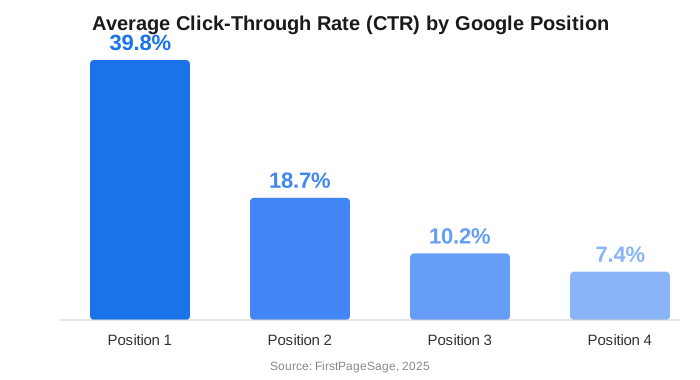
Moving from position 4 to position 2 can double your traffic, even without any increase in search volume.
A construction business publishing a single generic “home renovation” article will struggle to compete against major national sites. But by building a set of precise content pieces (bathroom renovation, 2026 energy renovation grants, renovation quotes for older apartments…), it covers dozens of real, complementary searches, each with far less competition. That’s exactly the approach we’ve been applying on this blog since this summer, with “pillar” articles like this one and more targeted articles linking back to it.
Frequently Asked Questions
Is SEO still worthwhile with generative AI on the rise?
Yes, more than ever. Despite the rise of ChatGPT and generative AI, Google still sends 345 times more traffic to websites than ChatGPT, Gemini, and Perplexity combined (Ahrefs, 2025). As we explained in our article on Google’s AI Overviews, solid classic SEO remains the prerequisite for being cited by AI itself.
How long does it take to see SEO results?
Expect roughly 4 to 6 months for the first visible effects, and several more months for real traction. SEO is a long-term investment, not a lever for instant results like paid advertising.
Do you absolutely have to rank #1?
It’s the ideal goal, but aiming for the top 3 is already very profitable: the top three results alone account for over half of all clicks.
Is local SEO different from classic SEO?
It builds on the same fundamentals but adds specific levers (Google Business Profile listing, customer reviews, consistent contact info online). We cover it all in our dedicated article on local SEO.
