
Invoicing and Accounting for Small Businesses: What French Law Requires in 2026
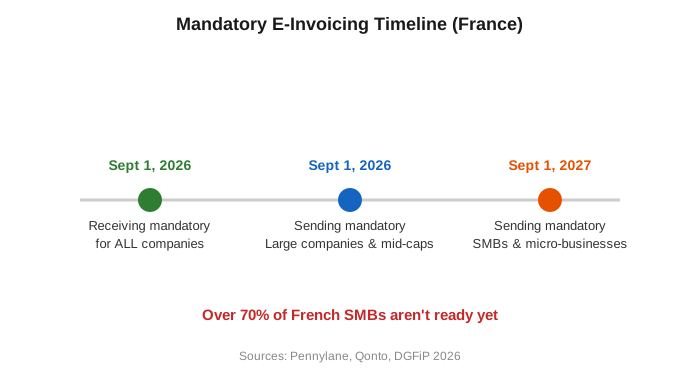
In just a few days, on September 1, 2026, a major legal requirement takes effect for every French company subject to VAT: the ability to receive electronic invoices. Yet according to a Qonto study, over 70% of French small businesses aren’t ready. This guide breaks down what the law actually requires around invoicing and accounting for a small business in 2026.
What the Law Requires Today
- No strict requirement to use invoicing software as such, but a certification requirement once the software records your customers’ payments (VAT anti-fraud law)
- Starting September 1, 2026, every company subject to VAT must be able to receive electronic invoices via an approved platform
- The cost of late payments for French SMBs is estimated at €16 billion a year (Banque de France), a problem the e-invoicing reform is partly designed to fix
You might assume this reform only affects large companies in the short term, since small businesses aren’t required to issue electronic invoices until September 2027. That’s a costly mistake: as of September 1, 2026, your small business already needs to be able to receive electronic invoices, including from large suppliers who are switching over immediately. Without an operational approved platform, you risk being unable to process invoices from some of your most important partners.
The Full Reform Timeline
We cover every step, which platforms to choose, and the penalties involved in our dedicated article on mandatory e-invoicing.
3 Accounting Obligations You Can’t Afford to Overlook
1. Mandatory Information on Every Invoice
Number, date, seller and buyer identification, itemized products or services, amount excluding tax and VAT: missing any of these exposes you to a fine, even outside a formal tax audit.
2. Certification of Your Point-of-Sale or Invoicing Software
Under the VAT anti-fraud law, any software that records your customers’ payments must be certified, or you risk a fine that can run into the thousands of euros.
3. Choosing the Right Accountant
Nothing requires a small business to have an accountant, but past a certain volume of activity, it quickly pays for itself: a professional selects and configures the right software, ensures compliance, and anticipates regulatory deadlines like e-invoicing.
A 6-person carpentry business discovers in August 2026, during a conversation with its accountant, that it needs to choose an approved platform before September 1 to keep receiving invoices from its main materials supplier, who has already switched to e-invoicing. Acting at the last minute, it narrowly avoids a disruption in processing supplier invoices, but admits it would have missed the deadline entirely without that conversation.
Frequently Asked Questions
Is my sole proprietorship affected by e-invoicing?
Yes, if it’s subject to VAT: receiving is mandatory from September 2026, sending from September 2027.
Is invoicing software mandatory?
Not strictly, but strongly recommended, and it must be certified if it records customer payments.
What happens if you’re not compliant with e-invoicing?
Fines that accumulate per invoice or per period without an approved platform, detailed in our dedicated article on the topic.
Should you switch accountants for the e-invoicing reform?
Not necessarily, but it’s a good time to check that yours is actively supporting you on this issue.
