
Local SEO: Why Your Google Listing Matters More Than Your Website
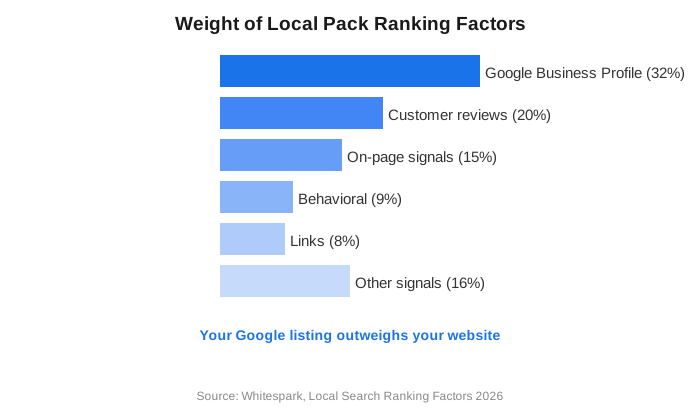
You’ve spent hours polishing your website, but it’s your Google listing that decides whether customers find you at all. According to the Whitespark Local Search Ranking Factors 2026 study, the industry’s global benchmark, Google Business Profile signals account for 32% of Local Pack rankings, compared to just 15% for your own website’s signals. In other words: in local SEO, your Google listing matters more than your site.
Why Local SEO Changes Everything for a Small Business
- 87% of consumers use Google to find a local business (Statista, via Thomas Lopes)
- 76% of people who do a “near me” search visit a business within 24 hours (Think with Google)
- 88% of local mobile searches lead to an in-store visit within a week (Think with Google)
- Businesses in the top 3 of the Map Pack get 126% more traffic and 93% more actions (calls, direction requests) than those ranked 4 to 10 (Semrush, via Digitiz)
Most small business owners assume review freshness matters less than total review count. That’s wrong, and increasingly so every year. In 2023, review freshness was the 20th most important ranking factor according to Whitespark. In 2026, it’s in the top 5. In practice: a competitor collecting ten fresh reviews a month will overtake you and your 200 reviews from three years ago, all else being equal. Getting more than one review a week is worth roughly 1.7 positions on the ranking grid.
What Actually Matters in the Local Pack
The Levers to Prioritize
1. Fill Out and Sharpen Your Google Business Profile
Primary category is the number one ranking factor: always choose a precise category (“Plumber”) over a vague one (“Contractor”). A listing with photos generates up to 42% more direction requests and 35% more clicks to the website (Google).
2. Make Review Collection an Ongoing Habit
97% of consumers read reviews before choosing a local business. Responding to 80% or more of your reviews, including negative ones, produces a measurable ranking boost according to Whitespark. A negative review handled professionally becomes a public demonstration of reliability.
3. Keep Your Contact Info Perfectly Consistent (NAP)
Name, address, phone: this information needs to match exactly across your Google listing, your website, and every local directory. The smallest discrepancy muddies the signal Google receives.
Two plumbers in the same town: the first has 200 reviews accumulated over 3 years but hasn’t received a new one in six months. The second has only 40 reviews, but gets 4 to 5 new ones every month, thanks to a simple follow-up text sent after each job. At equal service quality, it’s the second one that climbs the Local Pack, exactly as the Whitespark study predicts.
Frequently Asked Questions
Do you still need a website if you have a great Google listing?
Yes: on-page signals still account for 15% of the ranking, and your site remains essential once the customer has reached your listing. For more, see our complete guide to organic SEO for small businesses.
How many reviews do you need to rank well?
There’s no magic threshold: top 3 listings average over 200 reviews, but it’s the steady flow of new reviews that matters most, not the total count.
Can you buy reviews to speed things up?
No: Google explicitly bans incentivized and fake reviews, with penalties that can go as far as suspending the listing.
Does local SEO work for businesses with no physical storefront?
Yes, as long as you hide the address and properly define your service areas in the Google Business Profile, limiting yourself to around twenty locations within a two-hour drive.
