
How to Adapt to Google’s AI Overviews and the End of Single-Keyword SEO
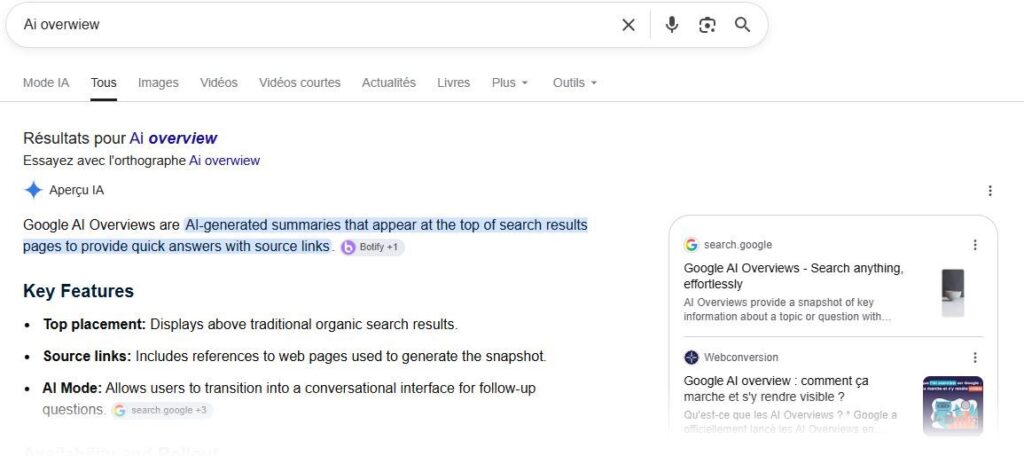
On July 22, 2026, Google rolled out AI Overviews in France, alongside AI Mode. France was one of the last major markets to get them. As a result, on roughly one search in four, an AI-generated answer block now appears above the organic results, often before users even think to scroll down.
For SMBs that rely on organic search to attract customers, this isn’t a minor cosmetic update. It’s a change in the rules.
What AI Overviews Actually Are
An AI Overview is a summary block generated by Google’s AI, displayed at the top of the search results page. It answers the user’s question directly, citing 2 to 4 clickable sources. Standard organic results are still shown below it, but most of the attention, and the clicks, now goes to that block.
The Numbers That Should Get Your Attention
Studies conducted since AI Overviews launched in the US all point in the same direction: organic click-through rates are collapsing on affected queries.
- The top organic position loses an average of 58% of its clicks when an AI Overview appears (Ahrefs, based on an analysis of 300,000 keywords).
- Being cited in an AI Overview multiplies click-through rate by roughly 2.3x compared to an uncited brand on the same query (Seer Interactive).
- 81% of sources cited in AI Overviews come from the top 10 organic results (Writesonic).
That last number matters. Being cited by Google’s AI and ranking well aren’t two separate battles, they’re two sides of the same strategy. Without solid classic SEO, there’s no citation in the AI Overview.
The Planned End of the Single Keyword
For a long time, the SEO playbook could be summed up in one sentence: pick a keyword, use it in the title, the headings, and the body text, then wait. That approach is losing its effectiveness. Google’s algorithms, like those behind conversational AI (ChatGPT, Perplexity, Gemini), now understand the topic, the search intent, and the relationships between concepts, well beyond the exact phrase a user types.
In practice, publishing ten articles each targeting a slightly different variation of the same keyword no longer delivers the edge it once did. Sites that instead build genuine content ecosystems, comprehensive, coherent, up-to-date coverage of a topic, are the ones gaining authority and lasting visibility.
How to Adapt Your Content Strategy
Here are the levers that make a real difference in 2026:
- Answer directly, right from the first lines.
Structure your articles like an inverted pyramid: the factual answer first, explanations and context after. That’s what generative AI extracts first. - Write self-contained passages.
Every important paragraph should be understandable and citable out of context, without needing to read the whole article. - Use question-based headings.
Generative AI loves answering precise questions, that’s exactly the format it’s looking to extract. - Add structured data.
Schema.org markup (Article, FAQPage, HowTo) helps engines understand and reuse your content. - Lean on tables, lists, and FAQs.
These formats are especially well suited to how generative AI builds its answers. - Strengthen your credibility (E-E-A-T).
Experience, expertise, authority, and trust are still what separates a source that gets cited from one that gets ignored. - Keep your content up to date.
An outdated article loses its place in citations, even if it performed well for years.
What Hasn’t Changed
Classic SEO fundamentals, domain authority, internal linking, technical site quality, organic ranking, remain the foundation of any visibility. GEO (Generative Engine Optimization, the art of being cited by generative AI) doesn’t replace SEO. It builds on top of it.
Summary
| Before (single-keyword SEO) | Now (SEO + GEO) |
|---|---|
| One article = one target keyword | A content ecosystem = one topic covered in depth |
| Repeat the keyword throughout the text | Answer the question directly, from the first lines |
| Goal: rank #1 | Goal: get cited in the AI Overview |
| Success measured in clicks | Success measured in visibility and citations |
| Continuous prose | Self-contained passages, lists, tables, FAQs |
| Occasional updates | Content kept continuously up to date |
Conclusion
The arrival of AI Overviews in France doesn’t spell the end of organic search, but it does change what it takes to succeed at it. SMBs that keep publishing generic content spread across dozens of near-identical keywords will see their traffic erode. Those that build comprehensive, well-structured, trustworthy content, on the other hand, have a real opportunity: being cited becomes a competitive advantage in its own right.
