

Mandatory E-Invoicing: What Changes on September 1, 2026
Tomorrow, on September 1, 2026, e-invoicing becomes a legal requirement for every French company subject to VAT, at least for receiving invoices. According to a Qonto study, over 70% of French small businesses aren’t ready, often simply because it’s unclear what’s actually changing. Here’s the essential, no jargon.
The Exact Timeline
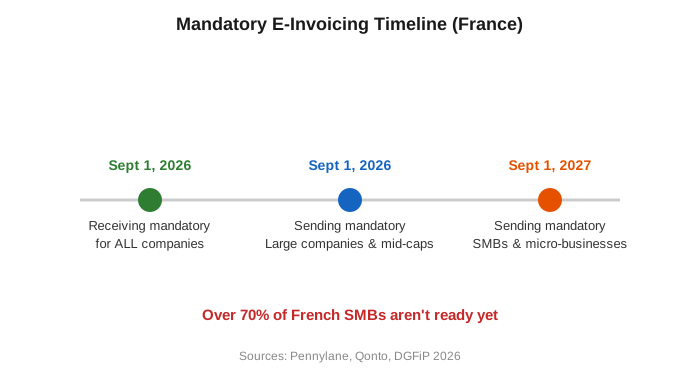
- September 1, 2026: every company subject to VAT must be able to receive electronic invoices via an approved platform
- September 1, 2026: large companies and mid-caps (ETI) must issue their invoices in electronic format
- September 1, 2027: small and micro businesses must, in turn, issue their invoices in this format
Most small business owners wrongly assume the reform doesn’t affect them until 2027, since that’s the deadline imposed for issuing their own invoices. That mistake will cost many of them: as of this week, they need to be able to receive electronic invoices, including from large suppliers switching to the new format on September 1, 2026. Without an operational approved platform (PDP) right now, the risk isn’t just a fine, it’s being unable to process invoices from some of your most important partners.
What You Actually Need to Do
1. Choose an Approved Platform (PDP)
Over 147 partner dematerialization platforms are approved by the DGFiP, France’s tax authority. The right choice depends on your current accounting software, invoice volume, and budget.
2. Check Your Accounting Software’s Compatibility
Electronic invoices must follow a structured format (Factur-X, UBL, or CII), not a simple PDF sent by email.
3. Plan for E-Reporting
For sales to consumers or international customers, a separate system called e-reporting transmits transaction data to the tax authority, following the same timeline.
Penalties for Non-Compliance
According to platforms specializing in the reform, penalties include a fine for not having an approved platform (€500 from September 1, 2026, then €1,000 every 3 months), a fine per non-compliant invoice (roughly €15 to €50 depending on the source, capped annually), and a fine per e-reporting failure. These amounts are modest compared to the real operational risk: no longer being able to exchange invoices with partners who are already compliant.
A small business that subcontracts for a large industrial group receives an email in late August 2026 informing it that, starting September 1, all its invoices will go exclusively through an approved platform. Having not planned ahead, the business has to choose a solution urgently to avoid payment delays on its own supplier invoices. The total cost of late payments for French small businesses already reaches €16 billion a year (Banque de France), no need to add an avoidable cause to that number.
Frequently Asked Questions
Do I need to choose a platform before September 1, 2026?
Yes, to be able to receive electronic invoices from suppliers who are already compliant, even if you’re not yet required to issue yours in that format.
Does a PDF sent by email count as an electronic invoice?
No, the invoice must follow a structured format (Factur-X, UBL, or CII) and go through an approved platform.
What happens if you’re not ready on September 1, 2026?
You risk a progressive fine and, more importantly, being unable to process invoices from partners already on the new format.
Does the reform also apply to sales to consumers?
B2C and international sales fall under e-reporting, separate from B2B e-invoicing but on the same timeline.
