

Artificial Intelligence in Business: The Practical Guide for Small Businesses in 2026
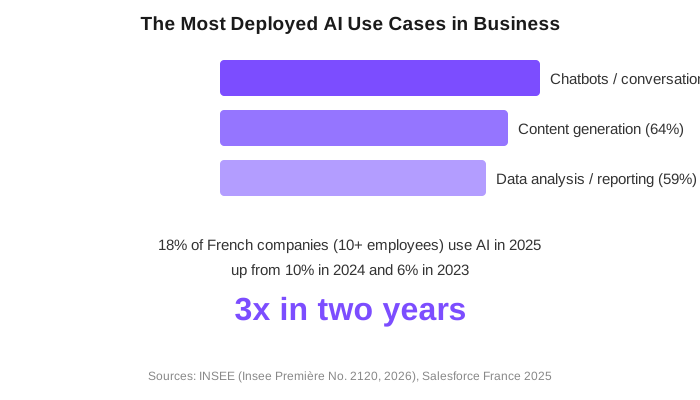
If you’re still hesitant to bring artificial intelligence into your small business, you’re not alone, but you’re an increasingly small minority. According to INSEE, France’s national statistics agency, 18% of French companies with 10 or more employees used AI in 2025, up from 10% in 2024 and just 6% in 2023: adoption has tripled in two years. This guide covers what actually works for a small business in 2026, without the jargon.
Where AI Adoption Really Stands Among French SMBs
- 18% of companies with 10+ employees use AI in 2025, with a clear gap by size: 15% among 10-49 employees, 31% among 50-249 (INSEE Première No. 2120, 2026)
- 34% of French SMBs report using AI in some form, up from 13% a year earlier, including consumer generative AI tools (France Num Barometer 2025)
- Nearly 300,000 French SMBs, or 47% of them, have launched at least one AI project (Bpifrance annual report, 2026)
It’s often assumed that budget or lack of technical skill is what stops small businesses from adopting AI. That’s wrong in the vast majority of cases. According to INSEE, the number one reason companies don’t use AI is lack of perceived usefulness (71%), well ahead of lack of internal expertise (54%). The problem is almost never technical: it’s a matter of not having identified a concrete use case.
The Use Cases Delivering the Most Value
1. Chatbots and Conversational Agents
This is the most widespread use case (71% of companies deploying AI). A well-configured chatbot handles recurring customer questions around the clock without tying up a staff member.
2. Content Generation
Drafting an email, roughing out a note, turning a content idea into a first draft in two minutes: the barrier to entry has dropped to the price of a regular monthly subscription, no IT budget or specialized technical skill required.
3. Data Analysis and Automated Reporting
59% of companies using AI apply it to analyzing their own data, spotting trends a manual review would likely miss.
4. Autonomous AI Agents: The Next Wave
Unlike classic chatbots, an AI agent can act autonomously to reach a goal: tracking a supply chain, anticipating a stock shortage, adjusting ad spend based on actual sales. Gartner predicts 40% of enterprise applications will integrate specialized AI agents by the end of 2026, up from under 5% in 2025. We cover this in detail in our article on AI agents for automating without hiring.
A self-employed plumber uses an AI assistant to automatically draft quotes from a simple spoken description of the job, plus a chatbot on his site to answer common questions (pricing, service areas, emergencies) outside working hours. Result: fewer missed calls, quotes sent the same day instead of the following week. No technical skill was needed to set it up.
Frequently Asked Questions
Do you need a big IT budget to get started?
No. 70% of SMBs that have adopted AI started with an existing software solution rather than a custom-built project (Bpifrance). Many generative AI tools are accessible for the price of a standard monthly subscription.
Will AI replace my employees?
In the vast majority of cases observed among small businesses, AI automates repetitive tasks rather than entire jobs, freeing up time for higher-value work.
Which use case should you start with?
Whichever problem is most concrete and recurring in your business: answering customer questions, drafting documents, or analyzing your own sales data.
Are there rules to follow (data protection, transparency)?
Yes: European regulation requires disclosing the artificial nature of certain content, plus stricter rules for high-risk uses (HR, credit). We cover this in our cybersecurity and compliance guide for small businesses.
