
Chatbots: How to Automate Customer Service Without Losing the Human Touch
A poorly designed chatbot does more harm than good: 68% of customers abandon a conversation if the chatbot doesn’t understand their request after two exchanges. That’s the kind of detail articles titled “AI will revolutionize your customer service” often leave out. Here’s how to automate without dehumanizing, with numbers that show exactly where to draw the line.
What Chatbots Actually Change for a Small Business
- Across 150 French small businesses that deployed an AI chatbot, average response time dropped from 4 hours to under 10 seconds, around the clock (Entreprise-Plus, 2026)
- 65% of requests are fully resolved by the chatbot without human intervention, mainly recurring questions (pricing, availability, timelines)
- The visitor-to-qualified-lead conversion rate rises by an average of 35%
- According to Forrester, a well-designed chatbot can fully and autonomously handle up to 30% of routine customer service requests
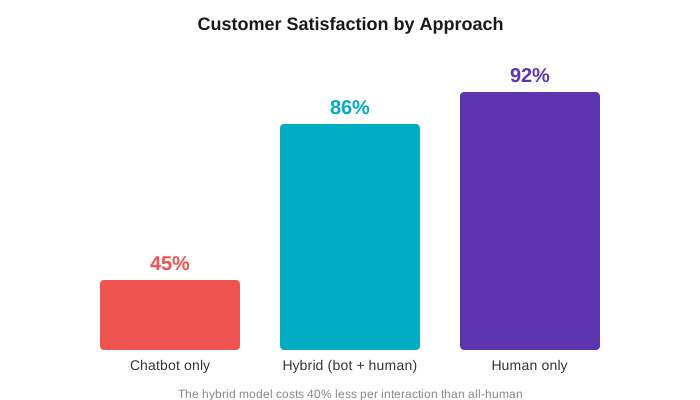
Customer satisfaction reaches 92% with a human agent, versus just 45% with a chatbot alone. And a chatbot’s first-contact resolution rate tops out around 55% for complex requests. Automating 100% isn’t the goal, then: it’s the hybrid model, bot for simple questions, automatic handoff to a human as soon as complexity rises, that delivers the best results.
Chatbot Only vs. Hybrid vs. Human Only
How to Get Your First Chatbot Right
1. Start With FAQs, Not Everything
If your team answers the same 10 questions several times a day, that’s the most obvious and profitable starting point.
2. Build in an Automatic Human Handoff
As soon as the chatbot fails to understand a request after two exchanges, an immediate transfer to a human prevents the conversation from being abandoned.
3. Measure Before Expanding
After two weeks, review the automatic resolution rate, unanswered questions, and satisfaction score, then expand the knowledge base based on the gaps you find.
4. Check Where Your Data Is Hosted
For any business operating in France, GDPR compliance is essential: make sure exchanged data is hosted in Europe.
An online shop configures a chatbot for just its 15 most common questions (delivery times, returns, available sizes). More complex requests (complaints, disputes) automatically route to an inbox monitored by the team. Result after one month: 60% of incoming messages handled with no human involvement, and no drop in customer satisfaction, thanks to the systematic handoff whenever a question falls outside the defined scope.
Frequently Asked Questions
How much does a first chatbot cost for a small business?
Turnkey solutions available in 2026 let you have a first chatbot up and running in a day for under €100 a month.
Should the chatbot pretend to be human?
No, transparency (clearly stating it’s a bot) is a key factor in acceptance: 73% of consumers prefer AI for simple requests, provided they can escalate to a human.
Which metrics should you prioritize?
Average response time, first-contact resolution rate, customer satisfaction, and the volume of conversations handled per day.
Does a chatbot suit every type of business?
It’s particularly cost-effective for recurring, standardized questions. For high-value interactions (negotiation, complex complaints), a human agent remains irreplaceable.
